
You Don’t Need Better Data Before You Start

You need a better way to see where it’s breaking.
A crew runs over on a property. What happened? Was the estimate wrong? Was the crew inefficient? Was the schedule unrealistic? Did the hours get corrected later?
If you don’t trust the data in Aspire, those questions are surprisingly hard to answer.
That was the starting point for two commercial maintenance landscape branches earlier this year. Ninety days later, the picture looked completely different, and they made that progress during the busiest part of the year. That matters because one of the most common things we hear is:
“We need to clean up our Aspire data before BomData will be useful.”
These two branches proved the opposite.
They didn’t start with clean data
The first problem wasn’t crew efficiency or property profitability. It was more basic: could they trust the information underneath those numbers?
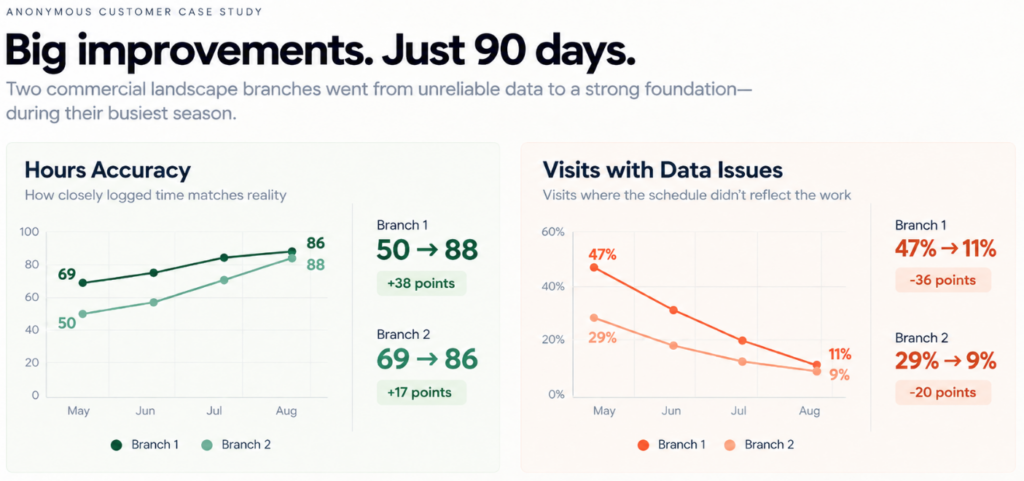
At one branch, Hours Accuracy averaged just 50 out of 100, a sign that time entries often weren’t lining up cleanly with when work actually happened. Also, 47% of visits had a mismatch between the schedule and the work happening in the field.
The second branch was in better shape, but it still had plenty of room to improve. Its Hours Accuracy averaged 69, with scheduling issues on 29% of visits.
That creates a problem far beyond reporting. If actual hours aren’t trustworthy, an inefficient-looking property may actually have bad time entries. If the schedule doesn’t reflect what crews were really expected to do, it’s hard to judge the crew against it. And when renewal season comes around, you’re left trying to determine whether a contract was underbid or simply poorly executed.
You can pull more reports, but more reporting doesn’t solve uncertainty in the inputs.
The process was much simpler than “clean up Aspire”
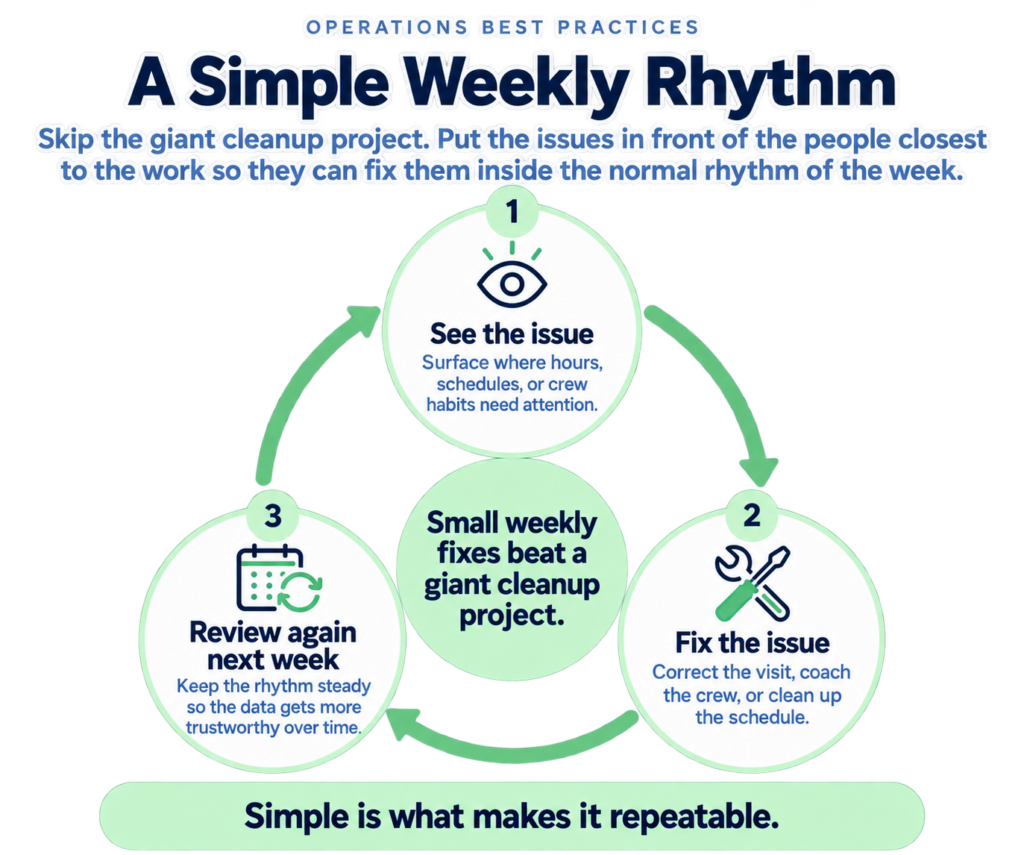
Nobody needed to audit every ticket in the system or launch a months-long data initiative. Instead, BomData made a few recurring problems visible: where time-entry habits were breaking down, where schedules didn’t match the work, and which crews or visits needed attention. That gave managers something specific to work on.
Instead of:
“Our Aspire data needs to get better.”
The conversation could become:
“Here are the visits that need to be corrected this week.”
Then they did it again the next week, and the week after that.
There’s nothing especially sophisticated about that rhythm. In fact, that’s part of why it worked. Frontline operations teams don’t need another complicated dashboard with ten KPIs competing for attention. They need a small number of clear signals that tell them where to look. The process can feel almost boring: see the issue, fix the issue, review it again.
But boring is repeatable.
In 90 days, the foundation changed
By July and August, both branches were operating with significantly more trustworthy data. One branch improved its Hours Accuracy from 50 to 88, while reducing its scheduling error rate from 47% to 11%.
The other improved from 69 to 86, while its error rate fell from 29% to 9%. By August alone, both branches had reduced scheduling errors to 8%, while Hours Accuracy reached 90.
This wasn’t a winter cleanup project when managers had plenty of spare time to sit in Aspire, the improvement happened through the summer. That’s what makes the result particularly useful for landscape companies waiting for a quieter season to get their data under control. You don’t need to stop and clean everything before the data can become useful.
Using the data can be what helps you clean it.
Was it really improvement, or just the season?
We compared the two branches with similar branches that weren’t yet using BomData in the same market. Those branches were already strong and stayed fairly steady.
The BomData branches started far behind, then nearly caught them by August: 87 vs. 95 in Hours Accuracy and 8% vs. 6% in errors.
The takeaway isn’t that software did all the work, the teams did. BomData gave them a clear, repeatable way to see what needed attention.
Once you trust the inputs, you can start managing the operation
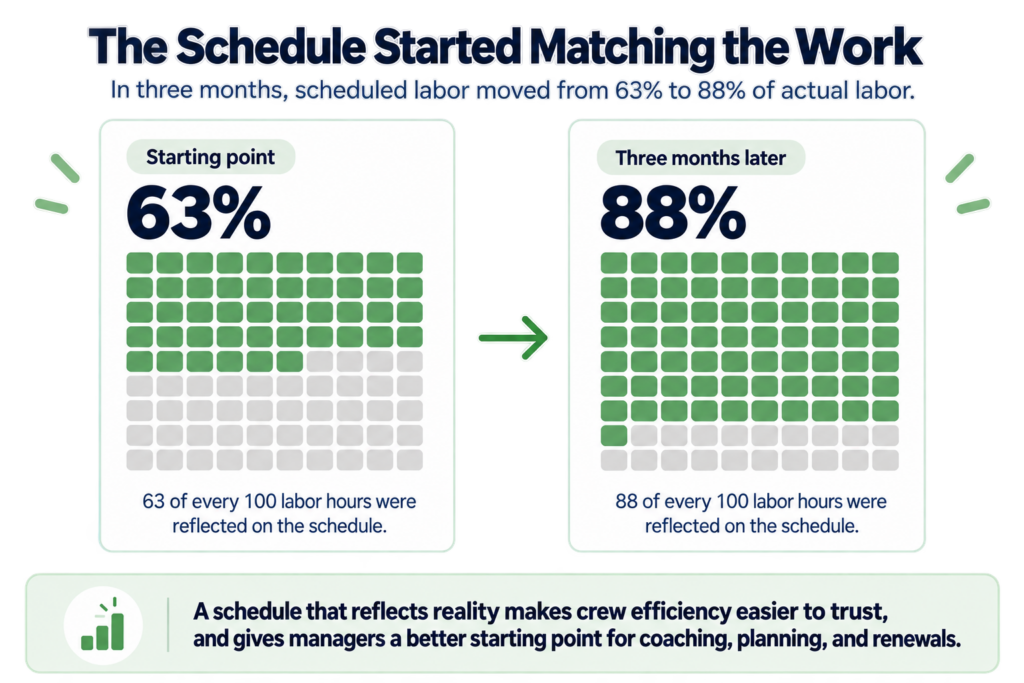
The bigger win was that managers could finally trust the schedule enough to manage from it.
In just a few months, the share of actual labor reflected on the schedule improved from 63% to 88%. Now, when a property runs long, the team can ask the right question: Was the crew inefficient, was the schedule wrong, or was the work underbid?
That’s the difference between reporting on what happened and actually improving operations.
Simple reporting can be a strength
There’s another lesson in this case study that’s easy to overlook: none of this required an elaborate reporting environment.
The branches improved because the information became simple enough to use consistently: a few important metrics, clear problem areas, and a steady review rhythm through weekly automated emails. That simplicity matters.
A sophisticated report can answer an enormous number of questions. But if a route manager has to spend 30 minutes interpreting it before deciding where to focus, it may never become part of the weekly operating rhythm.
The frontline needs something different:
What’s wrong? Where is it happening? What should I look at this week?
That’s deliberately a much simpler job. And when managers can answer those questions quickly, the organization can build from there.
You don’t have to get clean before you start
These branches still have work to do. But in 90 days, they went from questioning their data to using it to manage the business. No massive cleanup project, no analyst, no complicated dashboard rollout. Just clearer visibility into where things were going wrong, and a steady rhythm for fixing them.
BomData helps turn “we know our data is messy” into “here’s exactly what we need to work on this week.”
That means better schedules, more trustworthy crew efficiency, clearer property performance, and stronger renewal decisions. If you’re waiting to get Aspire cleaned up before doing more with your data, you may be waiting for the wrong thing.
Start by making the problems visible. Then improve them.
Get STarted
Work Toward Operational Efficiency
Take the first step toward operational efficiency for your landscaping business today with BomData. Contact us today for a free demo or to get started.
©Copyright BomData 2025